
TL;DR
- Geothermal heating uses the earth’s stable underground temperature — 45 °F to 75 °F year-round across most of the U.S. — to heat and cool your home instead of burning fuel or fighting outdoor air temperature.
- It runs at 400–520% efficiency (COP 4.0–5.2). The best gas furnace on the market tops out around 95%.
- Installed cost for a typical home runs $24,000–$36,000, with the buried ground loop accounting for 40–60% of the total.
- Most homeowners cut heating and cooling costs by 50–70%. Payback is 5–9 years when replacing fuel oil or propane, 10–15 years when replacing natural gas.
- The federal Section 25D residential credit expired December 31, 2025. State rebates, utility programs, and the 30% Section 48 commercial ITC are still active.
What Is Geothermal Heating for Homes?
Geothermal heating — also called ground-source heating or a geothermal heat pump system — is a way of heating and cooling a house using the constant temperature of the ground beneath it.
Six feet below the surface, the earth stays remarkably stable. In Minnesota it holds around 45 °F all year. In Florida it holds around 72 °F. It does not swing with the weather. That January morning when the air outside is -10 °F, the ground under your yard is still sitting at 48 °F. That August afternoon when the air is 98 °F, the ground is still at 48 °F.
A geothermal system taps into that stability. Instead of generating heat by burning oil, propane or natural gas, it moves heat between your house and the ground. Moving heat takes far less energy than creating it, which is why geothermal is the most efficient residential heating technology available.
This is not experimental technology. According to the U.S. Department of Energy’s 2025 Geothermal Market Report, 1.27 million American homes and 27,300 commercial buildings are already heated and cooled this way. The states with the highest residential adoption are Florida, Tennessee and North Carolina — which surprises people who assume geothermal is a cold-climate product. It works everywhere, because the ground is stable everywhere.
How Geothermal Home Heating Works
A geothermal heating system has three parts. Understanding all three is what separates homeowners who get a good installation from those who get a disappointing one.
The Ground Loop
The ground loop is a closed circuit of high-density polyethylene (HDPE) pipe buried in your yard and filled with a water and food-grade antifreeze solution. This fluid circulates continuously, absorbing heat from the earth in winter and depositing heat into the earth in summer.
The loop is the part of the system that lasts longest. Properly installed HDPE loops carry 50-year warranties and routinely outlast the house. It is also the part that drives most of the installation cost, because it involves either drilling or excavation.
The Heat Pump Unit
Inside your home — typically in a basement, mechanical room or utility closet — sits the heat pump itself. It contains a compressor, two heat exchangers, an expansion valve and a refrigerant circuit. It works on the same principle as your refrigerator, just in reverse and at a much larger scale.
The single most important specification here is the compressor type. Older systems use single-stage compressors that are either fully on or fully off. Better systems use two-stage. The best systems use a true variable-speed inverter compressor that modulates continuously from 20% to 100% of capacity, matching your home’s actual heat demand minute by minute rather than overshooting and shutting off.
That difference is not marketing. A single-stage system cycling on and off wastes energy on every startup and produces noticeable temperature swings. A continuously modulating system runs at low output most of the time, uses less electricity, holds temperature within a degree, and puts far less mechanical stress on the compressor — which is why variable-speed units typically last longer.
The Distribution System
Finally, the heat has to get into your living space. There are two ways:
- Ducted (forced air) — moves heated or cooled air through ductwork. The obvious choice if your home already has central air distribution.
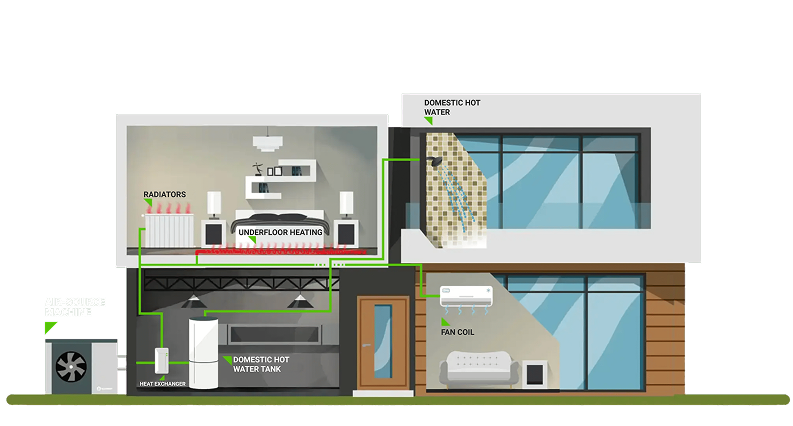
- Hydronic (water-based) — circulates warm or cool water through radiant floors, baseboards, wall radiators or fan coils. Quieter, more even, no drafts, and the best option for new construction or homes that already have radiators.
Some advanced systems handle both at once, plus domestic hot water and pool heating. For a walkthrough of every service a modern system can deliver, see our residential applications overview.
The Four Types of Ground Loop
Your installer will recommend one of four loop configurations. The choice depends on how much land you have, your soil and rock conditions, and your budget.
Vertical closed loop. Boreholes drilled 150–400 feet deep, typically one borehole per ton of capacity. This is the most common residential configuration in the U.S. because it needs very little surface area — often just a strip of side yard. It is also the most expensive, because drilling rigs are expensive.
Horizontal closed loop. Pipe laid in trenches 4–6 feet deep, spread across a larger area. Considerably cheaper than vertical if you have the land — generally you need roughly a quarter to a half acre of open ground for an average home. Excavation disrupts landscaping, so this is easiest before a yard is finished.
Pond or lake closed loop. Coils of pipe submerged in a body of water on your property. If you have a pond of adequate size and depth, this is the least expensive option available by a wide margin.
Open loop. Draws groundwater from a well, passes it through the heat pump, and discharges it. Cheapest to install where permitted, but requires abundant groundwater, is regulated differently in every state, and carries long-term water-quality maintenance considerations. Most residential installations today use closed loops.
What Geothermal Heating Costs for a Home in 2026
Here are realistic installed costs for a complete residential system — heat pump unit, ground loop, distribution and labor:
| Home size | System capacity | Installed cost range |
|---|---|---|
| 1,500–2,000 sq ft | 3 tons | $18,000 – $28,000 |
| 2,000–2,500 sq ft | 4 tons | $24,000 – $36,000 |
| 2,500–3,500 sq ft | 4–5 tons | $28,000 – $42,000 |
| 3,500 sq ft and up | 5–6+ tons | $32,000 – $50,000+ |
Two things drive the spread within each range. First, loop type — a vertical loop can add $8,000–$15,000 over a horizontal loop for the same capacity. Second, whether you need new distribution. Adding ductwork or radiant flooring to a home that lacks it is a separate project with its own cost.
The number that surprises most homeowners is how the total breaks down: the ground loop is 40–60% of the project, and the heat pump unit itself is a smaller share than expected. That means upgrading from a mid-range unit to a premium variable-speed unit is a relatively modest increase on the total project cost — while delivering efficiency gains you live with for 20+ years. It is usually the best-value decision in the entire project.
For a full line-item breakdown, cost per ton, retrofit versus new construction comparison and financing options, see What Does It Cost to Put Geothermal in a House?
How Much You’ll Save Every Year
Savings depend entirely on what you are replacing. Geothermal delivers the same performance regardless — but the fuel you stop buying determines the size of the win.
| Currently heating with | Typical annual savings | Typical payback |
|---|---|---|
| Fuel oil | 55–70% | 5–9 years |
| Propane | 55–70% | 5–9 years |
| Electric resistance / baseboard | 60–70% | 6–10 years |
| Natural gas + central AC | 35–50% | 10–15 years |
For a 2,500 sq ft home in the Northeast spending roughly $3,200 a year on heating and cooling, a geothermal system typically brings that down to $900–$1,300 — a $2,000+ annual reduction that continues for the life of the system.
If you currently heat with oil, that comparison deserves its own analysis. See Geothermal vs. Oil Heat: Which Costs Less to Run in 2026?
There is also a durability dimension that rarely appears in payback math. A gas furnace lasts 15–20 years. A central AC condenser lasts 12–15. A geothermal heat pump lasts 20–25 years and its loop lasts 50+. Over a 30-year ownership period, the conventional path means replacing equipment twice. The geothermal path means replacing it once.
The Installation Process, Step by Step
A residential geothermal installation typically takes one to two weeks from mobilization to commissioning. Here is what actually happens.
1. Load calculation. A qualified installer performs a Manual J heat loss and heat gain calculation on your specific house — square footage, insulation, window area, orientation, air sealing. This determines system capacity. Skipping or shortcutting this step is the most common cause of a badly performing geothermal system.
2. Site assessment. The installer evaluates available land, soil and rock conditions, existing utilities, access for equipment, and local permitting requirements. This determines loop type.
3. Loop design. Loop length is calculated from the load calculation and the thermal conductivity of your ground. Under-sizing the loop is the second most common installation failure — it causes the system to gradually deplete the thermal reservoir and lose capacity over a season.
4. Permitting. Requirements vary widely by state and municipality. Well-drilling permits, electrical permits and sometimes water-discharge permits apply. A good installer handles this.
5. Loop installation. Drilling or trenching, pipe placement, grouting, and connection to a manifold. This is the disruptive phase — expect heavy equipment in your yard for two to four days.
6. Interior installation. The heat pump unit is set, connected to the loop, tied into the distribution system, and wired. If domestic hot water or pool heating is included, those circuits are connected here.
7. Commissioning. The system is charged, purged of air, balanced, and tested across operating modes. Flow rates, temperature differentials and refrigerant pressures are documented. Ask for a copy of the commissioning report — it is your baseline for the next 20 years.
What to Ask a Geothermal Installer
Installation quality determines whether a geothermal system performs as designed or disappoints. Use these questions to separate qualified installers from opportunists:
- Are you IGSHPA-accredited? The International Ground Source Heat Pump Association certifies loop installers specifically. It is the relevant credential.
- Will you perform a Manual J load calculation, and can I see it? If the answer involves square-footage rules of thumb, walk away.
- How did you size the ground loop? You want to hear about ground thermal conductivity, not a per-ton default.
- What compressor type is in the unit you’re quoting? Single-stage, two-stage or true variable-speed. This is the difference you feel every day.
- Is the equipment AHRI-certified, and at what rated conditions? Manufacturer performance claims should be traceable to AHRI 13256-1 test conditions.
- What warranties apply to the loop, the unit and your labor separately? Loop should be 50 years. Unit typically 10. Labor varies and is worth negotiating.
- How many geothermal systems have you installed, and can I speak to an owner three or more years in? Recent references are easy. Older ones tell you how the work held up.
Incentives and Rebates Available in 2026
The incentive landscape changed significantly at the start of 2026, and a lot of outdated information is still circulating online.
What ended: The Section 25D Residential Clean Energy Credit — 30% of project cost with no cap — expired for systems placed in service after December 31, 2025, under the One Big Beautiful Bill Act of 2025. The Section 25C credit for air-source heat pumps expired at the same time. If your system was placed in service on or before December 31, 2025, you can still claim it on your 2025 return, and unused credit from earlier years can still be carried forward.
What is still available:
- Section 48 commercial ITC — 30%, active through at least 2032. This applies to commercial buildings, multifamily housing, and leased residential property. If you own a rental home or an investment property, this is directly relevant to you. Bonus adders for energy communities, domestic content and low-income communities can push the effective credit considerably higher.
- State programs. Massachusetts (Mass Save), New York (NYSERDA Clean Heat), Maine (Efficiency Maine), Vermont, Colorado, Minnesota, Oregon and others maintain substantial geothermal-specific incentives. In the strongest states, stacked state and utility incentives can offset a meaningful share of what the federal credit used to cover.
- HEEHRA and HOMES rebates. These IRA-funded, state-administered programs remain in rollout. HEEHRA provides up to $8,000 toward heat pump installation for income-qualified households.
- Utility rebates. Most U.S. utilities offer $500–$5,000 per qualifying system. Check your utility directly — these are frequently overlooked.
Always verify current program status with your state energy office and a tax professional before making a purchase decision based on incentive availability.
Is Geothermal Heating Right for Your Home?
Geothermal is the strongest choice when several of these apply:
- You are building new. Loop installation is cheapest and least disruptive before landscaping exists, and hydronic distribution can be designed in from the start.
- You currently heat with oil, propane or electric resistance. The savings are largest and payback fastest.
- You live in a cold climate. Unlike air-source heat pumps, geothermal capacity does not degrade as outdoor temperature drops. No backup heat required.
- You expect to stay 10+ years. The economics reward long ownership.
- You have a pool, radiant flooring, or want to eliminate a separate water heater. Integrated systems can consolidate all of it into one unit.
Geothermal is probably not the right choice if your AC just failed and you need a replacement this week, if you may sell within five years, or if you have neither yard access for a loop nor budget for vertical drilling. In those cases a high-efficiency air-source heat pump is the more sensible path.
Not sure which category you fall into? Our guide to choosing the right geothermal system walks through the decision in detail.
Frequently Asked Questions
How much does geothermal heating cost for a home?
A complete residential installation typically costs $24,000–$36,000 for an average 2,500 sq ft home, ranging from about $18,000 for a small home with a horizontal loop to $50,000+ for a large home requiring vertical drilling. The ground loop accounts for 40–60% of the total.
Does geothermal heating work in cold climates?
Yes, and better than air-source alternatives. The ground loop stays at 45–55 °F regardless of outdoor conditions, so a geothermal system delivers full rated capacity at -20 °F exactly as it does at 50 °F. There is no cold-weather efficiency penalty and no backup heat requirement.
How long does a geothermal home heating system last?
The indoor heat pump unit lasts 20–25 years. The buried ground loop lasts 50 or more years and typically carries a 50-year warranty. By comparison, a gas furnace lasts 15–20 years and a central AC condenser 12–15.
How much yard space do I need for geothermal?
A vertical loop needs very little surface area — often a strip of side yard sufficient for a drilling rig to access. A horizontal loop typically needs a quarter to a half acre of open ground for an average home. If space is tight, vertical is the answer.
Can geothermal heat my home and my domestic hot water?
Yes, with the right equipment. Integrated systems generate domestic hot water alongside space heating, and in cooling mode they redirect waste heat into the water tank rather than rejecting it to the ground — producing hot water at very high efficiency. Some units, like the ecoGEO+ WWA, also handle pool heating and ice melting from the same unit.
Do I need to replace my ductwork for geothermal?
Usually not. If you have functional central ductwork sized for your load, a ducted geothermal system connects to it. Some homes need duct sealing or minor modification. Homes with radiators are candidates for a hydronic system instead, which uses the existing distribution.
Is geothermal heating worth it in 2026 without the federal tax credit?
In most cases yes, though the case is stronger in some situations than others. The 50–70% energy savings did not change. For homes replacing oil, propane or electric resistance heat, and for new construction, the economics still work well. For homes with cheap natural gas and a short ownership horizon, the payback is long enough that it becomes a comfort and durability decision rather than a purely financial one.
How disruptive is the installation to my yard?
Expect heavy equipment on site for two to four days during loop installation. Vertical drilling is contained to a small footprint but produces drilling spoils. Horizontal trenching disturbs a much larger area of lawn. Both are restorable, but mature landscaping and hardscape are genuine considerations.

Ecoforest manufactures geothermal and air-source heat pumps with over 30 years of European engineering experience, certified for the U.S. market by AHRI, ENERGY STAR, IGSHPA and NY-GEO. Explore our geothermal heat pump systems or talk to our team about your project.