

Hydronic vs. Forced Air Heat Pumps: The Definitive Comfort Comparison
Every American home with forced air carries the same hidden tax built into its walls: sheet metal boxes wide enough to swallow a filing cabinet, snaking through ceilings and soffits just to deliver something as simple as warm or cool air to a room. It works, more or less. But it was never the best way to do it, just the way this country standardized on decades ago. A water-to-water heat pump moves the same comfort through a pipe you could hold in one hand, and the difference shows up everywhere: in the ceiling height, in the utility bill, and in how quiet the house actually is.
- Water carries about 3,500x more heat per volume than air, so a hydronic system moves the same comfort through pipe instead of bulky ductwork.
- The U.S. Department of Energy estimates typical duct systems lose around 20% of conditioned air to leaks, holes, and poor connections before it reaches a room.
- A full-inverter hydronic heat pump holds room temperature within about ±1°F, versus ±3-4°F swings typical of on/off forced-air systems.
- Hydronic pipe fits inside standard stud and joist bays, no dropped ceilings or duct chases required, making it far more retrofit-friendly than a new duct run.
Why Air Ducts Are the Real Constraint in HVAC Design
The hydronic vs forced air heat pump question usually gets framed as an efficiency debate. It is really a distribution debate, and it starts with a simple fact: most of the world moves heating and cooling through water. The United States is one of the few places that standardized on moving it through air instead, largely because forced-air furnaces were cheap to mass-produce and easy to pair with a single system for heating, cooling, and ventilation in the postwar housing boom. Seventy years later, that default is still shaping floor plans, ceiling heights, and construction budgets, even though the physics behind it were never in air’s favor.
Air is a poor medium for carrying heat. It has low density and low heat capacity, which means moving a meaningful amount of thermal energy requires moving a very large volume of it, fast. That is why a duct serving a single bedroom needs a cross-section measured in square feet, not square inches, and why the air handler behind it needs a blower powerful enough to push that volume through fifty feet of sheet metal, several elbows, and a few dampers along the way.
Water carries roughly 3,500 times more heat than air for the same volume. A pipe you could wrap your hand around moves as much comfort as a duct large enough to walk through, without the blower, without the sheet metal, and without most of what goes wrong along the way.
How Air Ducts Lose Pressure and Performance
Ductwork does not fail all at once. It loses a little performance at every joint, every seam, every place a run passes through an unconditioned attic or crawlspace, and by the time a system is a decade old, the losses have usually become the largest inefficiency in the house.
The U.S. Department of Energy estimates that about 20 percent of the air moving through a typical duct system is lost before it ever reaches a room, mostly through leaky joints, disconnected sections, and poorly sealed boots at the register, and ENERGY STAR notes that improper duct installation alone can cut system efficiency by up to 30 percent. That is air your heat pump or furnace already paid to condition, dumped into an attic instead of a bedroom.
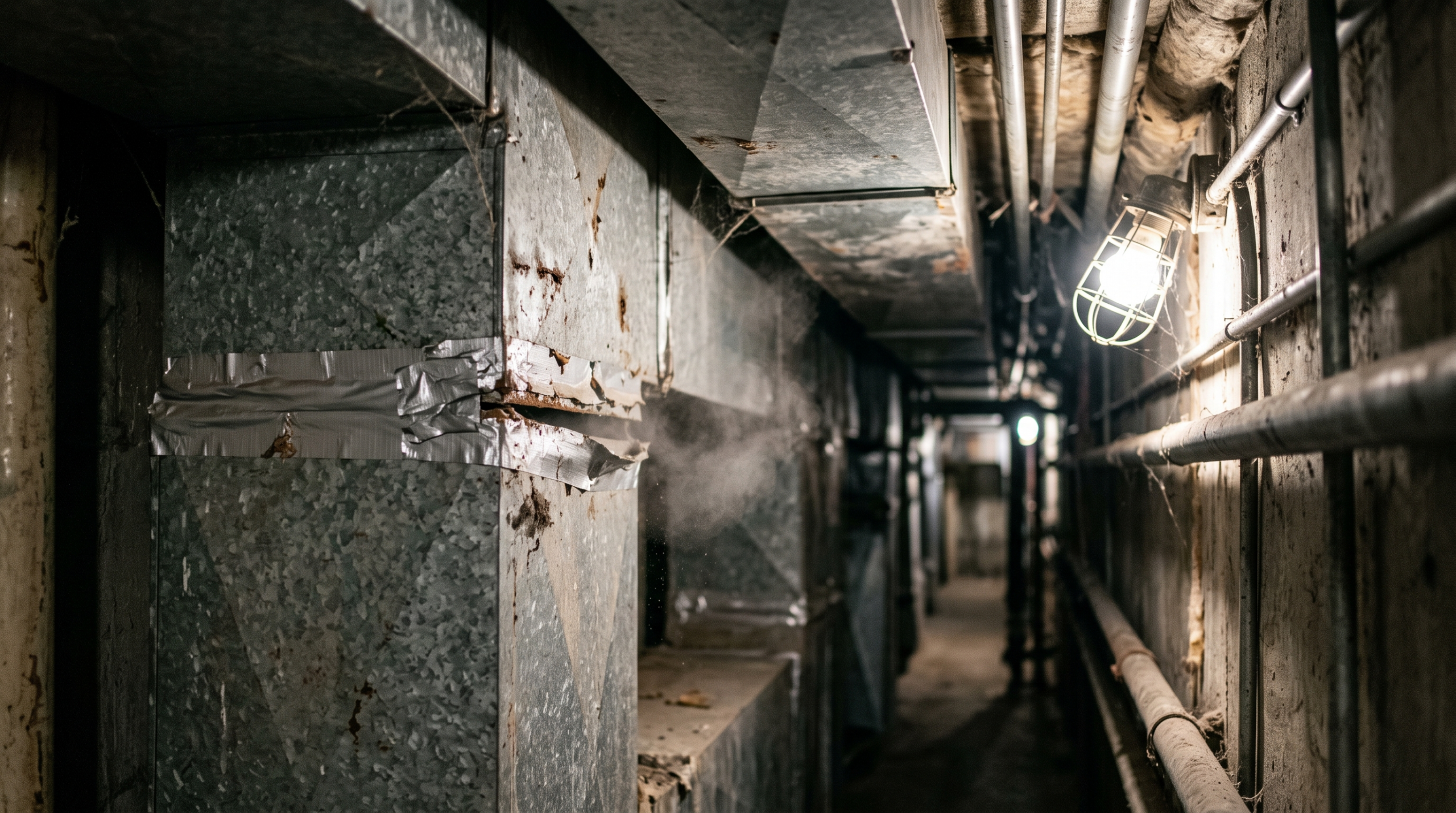
None of that is a defect in any one product. It is the nature of moving a large volume of air through a sealed sheet-metal network for fifteen or twenty years. Fittings shift, mastic ages, sections get disconnected during renovations and never reconnected properly. A closed, pressurized water loop simply does not have the same number of places to fail.
How Hydronic Water Distribution Works
A water-to-water heat pump, like the Ecoforest ecoGEO+ series, produces heated or chilled water instead of heated or chilled air. That water circulates through a sealed, pressurized loop to radiant floor tubing, fan coils, or both, delivering the same heating and cooling effect a forced-air system does, just through a completely different, much smaller distribution network.
Because the loop is closed and pressurized rather than open to the building’s air like ductwork, there is no equivalent of a duct leak. The water that leaves the heat pump is the water that arrives at the radiant floor or fan coil, at essentially the temperature it left at. The full inverter compressor in the ecoGEO+ modulates continuously rather than cycling on and off, so the water temperature stays consistent instead of swinging between a hot pulse and a cooling pause.
Space, Installation, and Design Freedom
A duct run needs straight sections wherever possible, a minimum cross-section to avoid excessive static pressure, and usually a dropped ceiling or a deep joist bay to hide it. That is a real constraint on a floor plan, and it is an even bigger one on a retrofit or an addition, where finding a path for a new duct run through finished space is often the single hardest part of the project.
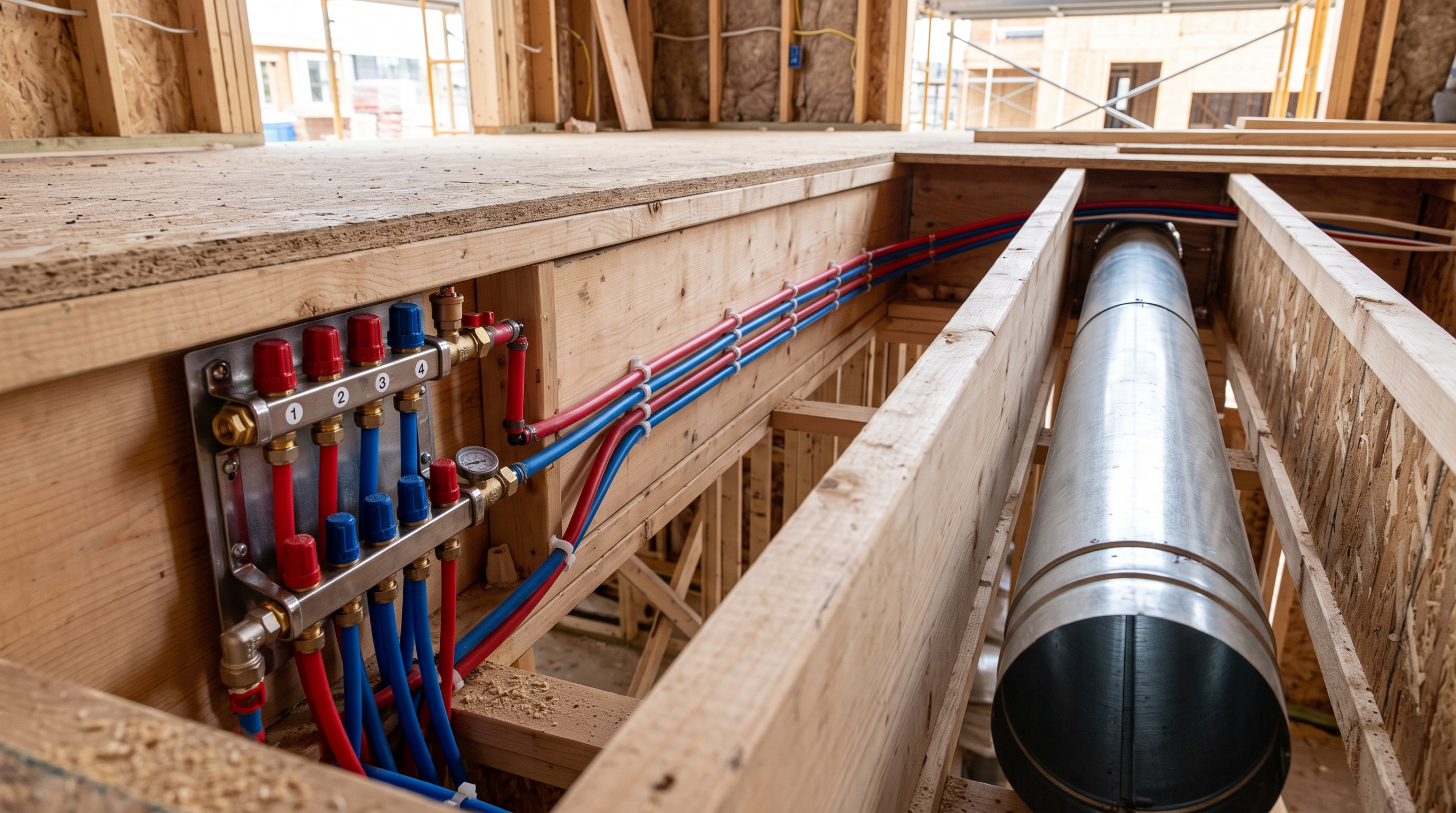
Hydronic pipe does not carry the same constraints. Half-inch to one-inch PEX or copper tubing routes through a standard stud bay, a joist bay, or a thin slab pour, wherever the building actually needs it to go, with no dropped ceiling required to hide it.
What It Takes to Move the Same Comfort
The same heating or cooling capacity that requires a duct wide enough to fill a joist bay end to end moves through hydronic pipe that occupies a fraction of the space, leaving the rest of that cavity for insulation, wiring, or nothing at all.
- Half-inch to one-inch tubing instead of 8 to 14-inch duct runs
- No dropped ceilings or duct chases required
- Routes through standard stud and joist bays
- Closed, pressurized loop with no equivalent of duct leakage
Not every project wants a fully hydronic house, and it doesn’t have to be all or nothing. The Ecoforest ecoGEO+ WWA blends a hydronic core with an integrated air handler for the rooms or additions where forced air already makes sense, while the fully hydronic ecoGEO+ domestic line skips ductwork entirely. Both are available now, and both start from the same full-inverter water-to-water heat pump. We’ll walk through when each makes sense in next week’s article.
The Comfort Difference: Cycling Air vs. Modulating Water
A single-stage or two-stage forced-air system has a narrow range of operating states: off, or running at a fixed capacity. When the thermostat calls for heat, the system runs at full output until the setpoint is reached, then shuts off completely. The result is a room that swings through a real temperature range, typically plus or minus 3 to 4 degrees Fahrenheit, punctuated by a blast of hot or cold air every time the system kicks back on.
A full-inverter water-to-water heat pump modulates its compressor output continuously, anywhere from around 20 percent to 100 percent of capacity, matching exactly what the building needs at that moment instead of overshooting and coasting. Combined with the thermal mass of radiant floor tubing or the steady output of a fan coil fed by that same modulating loop, the practical result is a room that holds within about 1 degree Fahrenheit of setpoint, with no blast of air and no audible cycling.
Comparing the Two Systems
| System | Distribution Medium | Typical Losses | Comfort Swing | Ceiling / Space Impact |
|---|---|---|---|---|
| Single/Two-Stage Forced Air | Large-volume air | ~20% duct loss | ±3-4°F | Dropped ceilings, deep chases |
| VRF (Ducted or Ductless) | Refrigerant / air | Lower than ducted air, refrigerant leak risk | Moderate | Moderate, refrigerant line sets |
| Water-to-Water Hydronic (ecoGEO+) | Small-volume water | Sealed, pressurized loop | ±1°F | Standard stud/joist bays |
No Duct Losses
A sealed, pressurized loop delivers the water at the temperature it left the heat pump at, with nothing lost to leaky joints along the way.
Fits Any Floor Plan
Small-diameter pipe routes through standard framing, making tight retrofits and additions far more practical than a new duct run.
Whisper Quiet
No blower forcing air through sheet metal, and no compressor slamming on and off. Full inverter modulation runs quietly in the background.
Radiant, Fan Coil, or Both
The same hydronic loop feeds radiant floor heating, fan coil cooling, or a combination, all from one water-to-water heat pump.
Frequently Asked Questions
See what your floor plan looks like without the ductwork.
Our team provides free technical support for architects, builders, and homeowners: hydronic layout, radiant floor design, and system specification for projects across the U.S. and Canada.
Or subscribe for technical guides and case studies.