
Vertical Geothermal Energy: Collection, Costs, and When to Choose It for Your Home
When looking for maximum energy savings and the lowest environmental impact to climate-control a building, geothermal energy stands out as the premier choice. Within this technology, vertical geothermal energy is the most advanced, stable, and efficient solution for providing heating, cooling, and domestic hot water (DHW).
If you are considering upgrading your energy system or building a new single-family home, this article explains in detail how vertical ground source collection works, its associated costs, when it is your best option, and why Ecoforest’s ecoGEO+ solutions set the standard in the market.
What is Vertical Geothermal Energy and How Does Collection Work?
Vertical geothermal energy is a climate control system that harnesses the constant temperature of the deep subsurface to condition a building. Unlike other systems, geothermal heat pumps are water-to-water systems. This means they extract heat from the earth via a heat-transfer fluid and transfer it to the home’s water circuit, such as radiant floor heating or radiators.
The ground collection process consists of the following steps:
- Drilling the ground: One or more vertical boreholes of a small diameter are drilled into the earth, typically reaching depths between 50 and 150 meters.
- Inserting the probes: A high-resistance polyethylene U-loop geothermal probe is lowered into each borehole, creating a closed circuit.
- Fluid circulation: A mixture of water and antifreeze (glycol) circulates through these pipes. In winter, the fluid absorbs heat from the earth and carries it to the heat pump; in summer, the process reverses, and excess heat from the house is dissipated back into the ground.
- Sealing the borehole: The remaining space between the probe and the borehole walls is filled with a specialized high-thermal-conductivity geothermal grout to guarantee optimal energy transfer and protect surrounding aquifers.
Key Advantages: When Should You Choose Vertical Collection?
Choosing the right type of ground collection depends heavily on your land conditions and available space. For a detailed comparison of terrains, you can consult our guide on vertical vs. horizontal geothermal energy.
However, vertical collection is the ideal path in the following scenarios:
- Small yards or limited plots: Because drilling is perpendicular to the ground, it requires minimal surface space. It is the perfect solution for homes with small lots or urban properties where laying down horizontal collectors is impossible.
- Extreme climates: Below a depth of about 15 meters, the Earth’s temperature remains stable year-round. This prevents system performance from fluctuating with the outdoor weather, providing greater stability than air-source systems (aerothermia).
- Maximum energy efficiency: By operating with such a stable thermal source, geothermal heat pumps achieve a COP (coefficient of performance) between 4 and 5. This means that for every kW of electricity consumed, 4 to 5 kW of thermal energy are generated.
- Superior durability: Because they are buried and protected from weather damage, solar radiation, or oxygen, vertical geothermal probes boast a lifespan exceeding 50 years with virtually no maintenance required.
Costs of a Vertical Geothermal Installation
It is no secret that vertical geothermal installations require a higher upfront investment than horizontal collection or air-source heat pumps, primarily due to the need for heavy drilling machinery.
The total cost of an installation is generally broken down into three main categories:
1. Borehole Drilling and Collection
This represents the largest economic variable. The price per linear foot or meter of drilling—which includes boring the hole, inserting the polyethylene probes, applying the thermal grout, and running the connections to the mechanical room—varies depending on soil hardness and geographic location.
2. The Equipment (Heat Pump)
The technology powering the heat pump itself. Investing in high-efficiency systems ensures optimal consumption modulation, which keeps monthly electric bills as low as possible.
3. Interior Installation
This includes the mechanical room connections, expansion tanks, buffer tanks, circulation pumps, and the home’s distribution system (with radiant floor heating being the most efficient pairing).
Is the investment worth it? While the initial price tag can be substantial, vertical geothermal technology offers the lowest operating costs. Monthly energy bill savings can reach up to 80% compared to fossil fuels. This drives an excellent payback period, turning the installation into a highly secure, value-adding property asset.
The Ecoforest Advantage: The ecoGEO+ Range
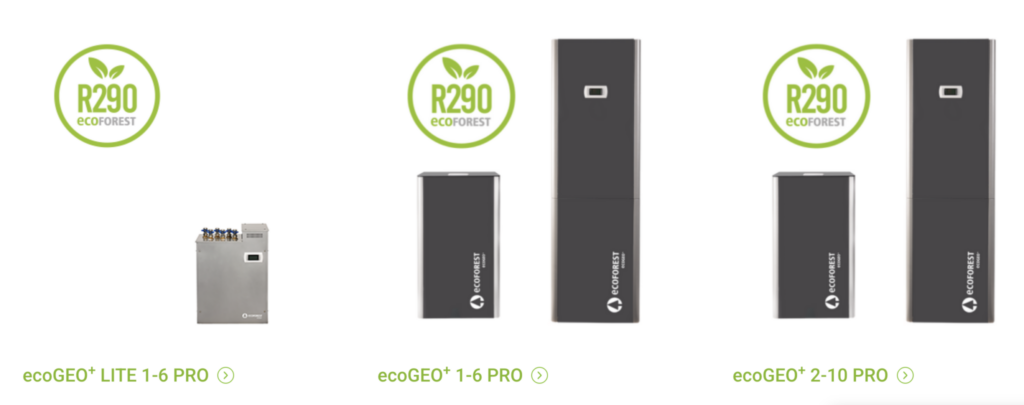
Ecoforest has a long history of driving innovation: we became the first Spanish manufacturer of geothermal heat pumps back in 2012. All of that engineering expertise is embedded into our ecoGEO+ range, designed specifically to squeeze every single watt of energy out of the subsurface using proprietary technologies.
Pioneering R290 Natural Refrigerant
In December 2020, we disrupted the industry again by becoming the first European manufacturer to launch a geothermal heat pump utilizing R290 (propane) natural refrigerant. The ecoGEO+ PRO range features this eco-friendly gas, which boasts a Global Warming Potential (GWP) of just 3. Thanks to its superior thermodynamic properties, it can deliver heating temperatures up to 70°C and DHW up to 75°C without needing any backup electric heaters.
ecoGEO+ PRO Models for Vertical Collection
| Model | Power Range | Efficiency (COP) | Recommended Application |
|---|---|---|---|
| ecoGEO+ 1-6 PRO | 1 – 6 kW | Up to 500% | New, highly efficient single-family homes or Passive Houses. |
| ecoGEO+ LITE 1-6 PRO | 1 – 6 kW | Up to 500% | Ultra-compact model (59 cm wide), perfect for tight indoor spaces. |
| ecoGEO+ 2-10 PRO | 2 – 10 kW | Up to 500% | Medium-sized single-family homes and retrofits. |
| ecoGEO+ 4-16 PRO | 4 – 16 kW | Up to 500% | Large single-family homes (>200 m²). |
Note: For much higher demands in large commercial complexes, hotels, or multi-family residential buildings, our ecoGEO+ HP (High Power) range can deliver up to 600 kW in cascade configurations.
Proprietary Technologies That Make a Difference
- Native Inverter Technology: All of our heat pumps utilize variable-speed Scroll compressors. They continuously adapt their power output to match the home’s real-time thermal demand, drastically minimizing start/stop cycles to extend the equipment’s lifespan and lower electricity bills.
- HTR (High Temperature Recovery) Technology: This patented heat recovery system harnesses high-temperature gases leaving the compressor to produce domestic hot water (DHW) simultaneously. In the summer, while the pump is actively or passively cooling your home, HTR technology heats your water practically for free.
- ecoSMART Intelligent Management: Our systems enable seamless integration with solar photovoltaic energy through the ecoSMART e-manager. This smart manager tracks solar surpluses and modifies heat pump parameters in real time to store energy as hot water or climate control, paving the way toward a zero-balance energy bill.
If you have a compact yard but massive ambitions for sustainability and long-term savings, installing a vertical geothermal system paired with Ecoforest technology is the most intelligent, future-proof decision you can make for your property.