
Quick answer: Air source heat pumps cost less upfront ($8,000–$18,000 installed) and are easier to retrofit, while geothermal (ground source) heat pumps cost more ($18,000–$45,000) but deliver higher, steadier efficiency, lower running costs, and a 25–50+ year lifespan. Geothermal wins on long-term value and cold-climate performance; air source wins on affordability and speed of installation. The right choice depends on your budget, climate, and how long you plan to stay in your home.
Both technologies do the same job — they move heat instead of burning fuel, providing heating, cooling, and often hot water from a single system. The difference is where they pull that heat from. Below, we break down how each works, then compare them across the factors that actually affect your decision.
How each system works
An air source heat pump (ASHP) extracts heat from the outside air, even in winter, and transfers it indoors. In summer it reverses, pulling heat out of your home. It’s the most common heat pump type in the U.S. because the outdoor unit installs much like a conventional AC condenser — no digging required.
A geothermal heat pump (GSHP), also called a ground source heat pump, exchanges heat with the ground instead of the air. A buried loop of pipe circulates fluid through soil or rock that stays at a stable 45–70°F year-round. Because it draws from a constant-temperature source rather than fluctuating outdoor air, it runs more efficiently — especially when it’s very cold outside.
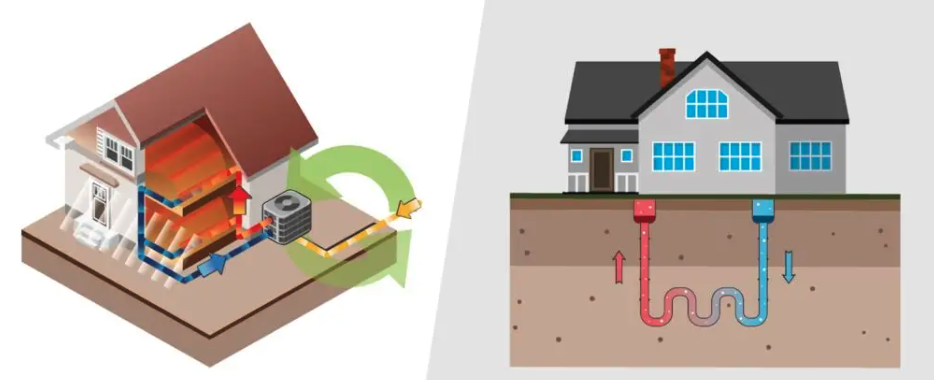
Side-by-side comparison
| Factor | Air Source Heat Pump | Geothermal Heat Pump |
|---|---|---|
| Typical installed cost | $8,000–$18,000 | $18,000–$45,000 |
| Efficiency (SCOP/COP) | High (e.g. SCOP ~4.5) | Highest, most stable (e.g. SCOP ~4.7) |
| Cold-climate performance | Good, dips in extreme cold | Excellent, largely unaffected |
| Installation | Fast, minimal disruption | Requires drilling/trenching |
| Lifespan | 15–20 years | Unit 20–25 yrs; loop 50+ yrs |
| Land required | None | Yard space or drilling access |
| Best for | Lower budgets, retrofits, milder climates | Long-term homeowners, cold climates, new builds |
Cost: upfront vs. lifetime
Air source heat pumps have the clear advantage on upfront cost. There’s no excavation, and the equipment and labor are comparable to a high-end AC-and-furnace replacement.
Geothermal costs more to install because drilling or trenching the ground loop accounts for 50–70% of the project. But over a 20–25 year horizon, geothermal often has the lower total cost of ownership: energy savings are larger and steadier, and the buried loop can outlast two or three air source units. Which one “wins” financially depends on your energy prices, climate, and how long you’ll own the home. As a rule of thumb, geothermal pays back best for homeowners staying 7+ years, especially those replacing fuel oil, propane, or electric-resistance heat.
For a full breakdown, see our guide on how much a geothermal heat pump costs in 2026.
Efficiency and cold-weather performance
Both systems are far more efficient than combustion heating — they deliver several units of heat per unit of electricity. The difference is consistency.
An air source heat pump’s efficiency dips as the outdoor temperature drops, because it’s harder to extract heat from very cold air. Modern units still perform well below freezing, but they work harder on the coldest days. A geothermal system taps the ground, which stays warm all winter, so its efficiency barely changes in January. Real-world field studies back this up: ground source systems tend to hit their rated efficiency far more closely than air source systems do across a full heating season.
If you live where winters are long and severe, this is often the deciding factor. See does geothermal heating work in cold climates? for more.
Installation and disruption
This is where air source pulls ahead. An ASHP can usually be installed in a day or two, and it’s the natural choice for retrofits or homes without yard space.
Geothermal requires either horizontal trenches (needs land) or vertical boreholes (fits smaller lots but requires specialized drilling). It’s more disruptive and takes longer, though new construction makes it far simpler and cheaper to include from the start.
The refrigerant question — and why it matters in 2026
There’s a factor many comparisons skip: the refrigerant inside the system. The EPA is phasing down high global-warming-potential refrigerants like R-410A that have been standard in U.S. HVAC for years. Choosing a system built on a future-proof refrigerant protects you from buying into technology on its way out.
This is where Ecoforest stands apart. Our ecoAIR+ air source range uses R290 (propane) — a natural refrigerant with a minimal global warming potential, well ahead of the regulatory curve. Our ecoGEO geothermal range pairs that efficiency-first engineering with a stable ground-source design. Both integrate our HTR Superheater technology, which produces domestic hot water up to 176°F (80°C) — solving the low-temperature limitation that affects many heat pumps — and connect to the Ecoforest Home app and Easynet for real-time optimization.
Which should you choose?
Choose an air source heat pump if you want the lowest upfront cost, need a fast retrofit, have no room for a ground loop, or live in a mild-to-moderate climate.
Choose a geothermal heat pump if you’re planning to stay in your home for many years, live in a cold climate, are building new, or want the lowest possible running costs and longest lifespan.
There’s no universally “better” system — only the one that fits your home, climate, and timeline. As Spain’s only geothermal heat pump manufacturer and a pioneer in R290 air source technology, Ecoforest builds both, so our guidance isn’t tied to selling you one over the other.
Frequently asked questions
Is geothermal more efficient than air source? Yes, generally. Both are highly efficient, but geothermal draws from the stable-temperature ground, so its efficiency stays high year-round — especially in cold weather, where air source performance dips.
Is air source cheaper than geothermal? Yes, upfront. Air source heat pumps avoid excavation, so installation costs much less. Geothermal can have a lower lifetime cost thanks to larger energy savings and a much longer loop lifespan.
Can I replace my furnace and AC with one heat pump? Yes. Both geothermal and air source heat pumps provide heating and cooling from a single system, and many models also produce hot water.
Which lasts longer? Geothermal. The indoor unit lasts 20–25 years and the buried loop 50+ years, versus roughly 15–20 years for an air source unit.
Ready to find the right fit for your home and climate? Talk to Ecoforest for guidance based on your specific situation. Learn more about our geothermal solutions and air source range.