Geothermal Heat Pumps for Multifamily Buildings: A Smarter Way to Heat, Cool and Save
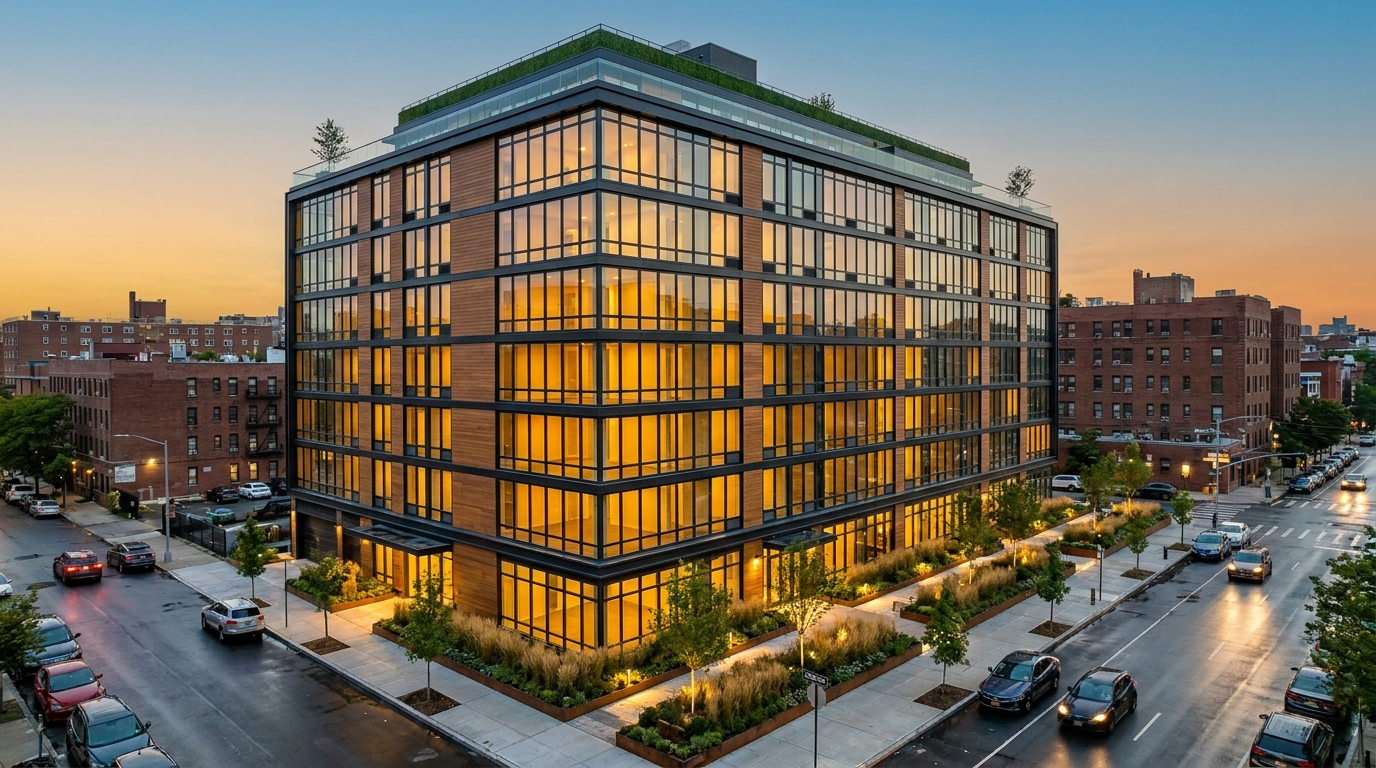
Walk into any mid-rise apartment building in America and you can hear the HVAC before you see it. The wall unit rattles in 3B. The window AC drips on the sidewalk outside 7A. And somewhere below in the mechanical room, an aging gas boiler runs year-round just to keep domestic hot water at temperature, dumping BTUs the building already paid for. None of it has to be this way. Water-to-water geothermal heat pumps have quietly become one of the most compelling upgrades a multifamily building can make, and the developers who are figuring this out early are locking in a serious long-term advantage.
Why Multifamily HVAC Is Broken
Multifamily buildings in the US are responsible for roughly 30% of total residential energy consumption, and a disproportionate share of that goes to heating, cooling, and domestic hot water. The problem is not a lack of technology. It is that the industry has been recycling the same three or four HVAC approaches for decades, none of them designed for what developers and building owners actually need in 2025 and beyond.
The three dominant systems you will find in multifamily buildings today each come with serious downsides that rarely show up in the original construction budget but hit hard over a 20-year operating life.
PTAC and Vertical Stack Units: The Noise Problem Nobody Talks About
Packaged terminal air conditioners (PTACs) and vertical stack heat pumps dominate mid-rise construction because they are cheap to install and easy to service per unit. But residents pay for that convenience in ways that are hard to quantify on a pro forma. PTAC units run compressors inside the living space. They cycle loudly. Temperature control is imprecise, and efficiency at extreme temperatures is poor because they are pulling heat from outdoor air that is either freezing cold or already scorching hot.
In luxury or Class A buildings, the noise issue alone is often disqualifying. Residents expecting the silence of a modern hotel room get something closer to a window unit in a budget motel.
VRF Systems: High Performance, Hidden Risk
Variable refrigerant flow (VRF) systems represent a major step up in efficiency and control. They can heat and cool different zones simultaneously, and the inverter-driven compressors are genuinely more efficient than traditional systems. But VRF comes with a risk that has become harder to ignore as buildings get taller and more densely occupied: refrigerant leaks.
In a multifamily VRF installation, refrigerant lines run through walls, ceilings, and chases across multiple floors and dozens of apartments. A single leak can affect air quality across an entire zone. High-GWP refrigerants used in most VRF systems are also increasingly regulated at the state level, and the replacement costs when a refrigerant-side component fails in year 12 are substantial.
Gas Boilers for DHW: A System Optimized for Another Era
Many multifamily buildings run a centralized gas boiler strictly for domestic hot water, sometimes paired with a separate VRF or chiller system for space conditioning. The boiler runs nearly continuously, maintaining a storage temperature to meet peak demand. It is not modulating. It is not recovering heat from any other building system. It is simply burning gas and waiting.
With natural gas prices increasingly volatile and new construction increasingly subject to electrification requirements in states like California, New York, and Massachusetts, locking in another gas boiler installation is a decision that will look worse with each passing year.
How Geothermal Works in a Multifamily Context
The principle behind water-to-water geothermal is straightforward. Instead of moving heat between refrigerant and outdoor air (which varies wildly in temperature), a geothermal heat pump moves heat between refrigerant and a ground loop. The ground stays at a relatively stable temperature year-round, roughly 50 to 60 degrees Fahrenheit at depth in most of the continental US. That stable source temperature is what makes geothermal so much more efficient than any air-source system.
In a multifamily building, there are two main ways to deploy this technology, and they are not mutually exclusive. The right answer for most projects is actually both.

Option 1: One Unit Per Apartment (ecoGEO+ Compact)
The first approach treats each apartment as its own geothermal zone. A compact water-to-water heat pump is installed inside each unit, typically in a small utility closet or mechanical niche. The unit connects to the building’s shared ground loop on one side and delivers both radiant floor heating and chilled water for fan coil cooling on the other. It also handles domestic hot water for that unit through an integrated heat recovery function.
This is not a new concept, but the Ecoforest ecoGEO+ Compact brings a level of performance and compactness that earlier generation units could not match. A variable-speed inverter compressor means the unit modulates output to match the actual load of the apartment rather than cycling on and off at fixed capacity. Temperature stability is within 1 degree Fahrenheit. Operation is silent enough that residents typically do not know it is running.
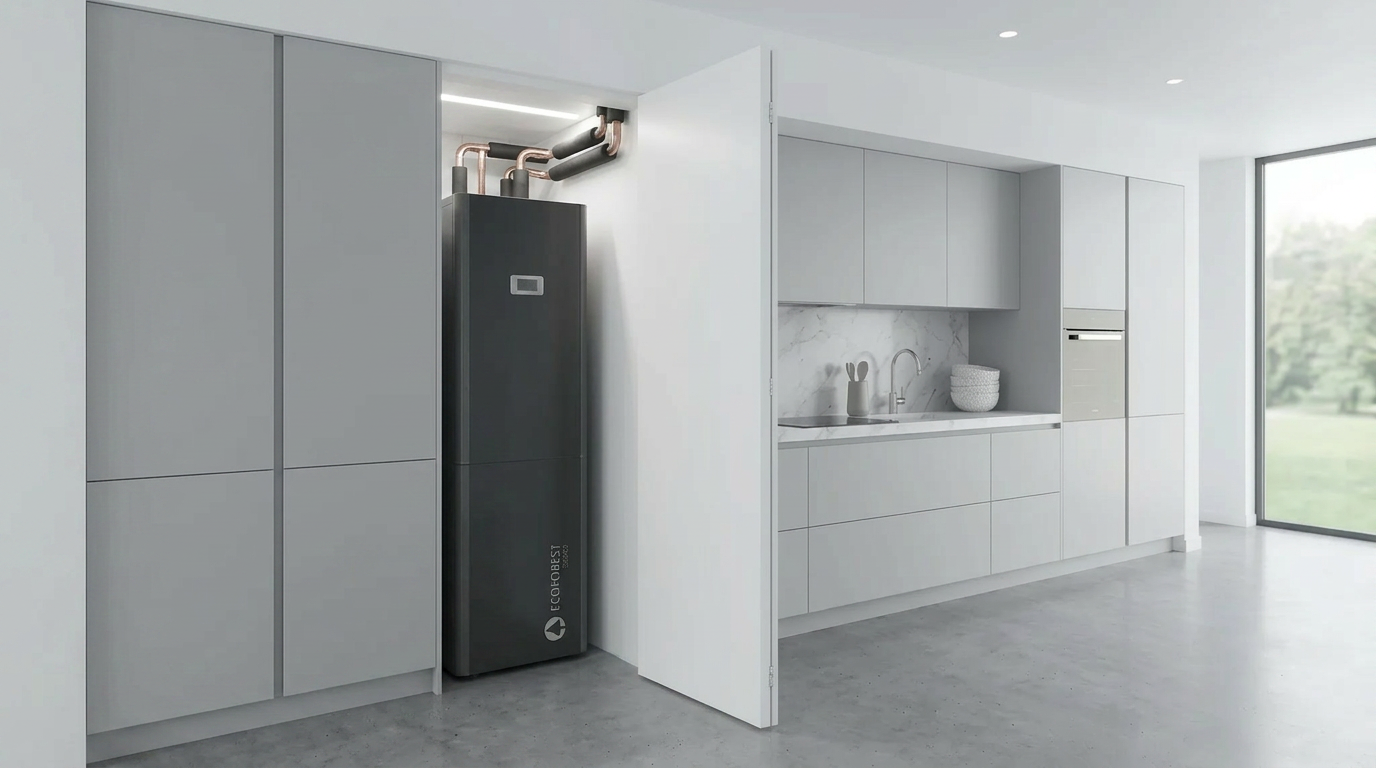
ecoGEO+ Compact
Designed specifically for the space constraints of multifamily construction. The ecoGEO+ Compact fits into a niche barely wider than the unit itself, leaving no wasted wall area and requiring no outdoor equipment.
- Full inverter compressor, R454B refrigerant
- Integrated DHW: no separate water heater needed per unit
- Heating + cooling + hot water in one compact unit
- Silent operation, zero outdoor footprint
- Connects to shared building ground loop
What the Ground Loop Looks Like at Scale
When you deploy one ecoGEO+ Compact per apartment, all units share the same ground loop. This creates an important thermal benefit that is often overlooked: the loop acts as a natural battery. Apartments on the south side of the building may be in cooling mode while apartments on the north side are in heating mode on the same afternoon in shoulder seasons. The heat rejected by the cooling units is absorbed by the heating units, dramatically reducing the net load on the ground loop and improving system-wide efficiency.
The key design requirement is proper loop sizing and balance. Ecoforest includes hydronic engineering support with every commercial project to ensure the loop handles the full range of simultaneous loads across the building without approaching freezing temperatures in the worst-case heating scenario.
One of the most underappreciated advantages of building-wide geothermal is the loop’s ability to absorb rejected heat in summer and release it in winter. A properly designed loop for a 60-unit building will see dramatically lower peak loads than 60 individually sized systems, because not every apartment is in the same mode at the same time. This is the efficiency multiplier that makes geothermal at scale outperform any per-unit air-source solution.
Option 2: Centralized Plant for DHW and Common Areas (ecoGEO+ HP)
The second approach is a centralized geothermal plant in the building’s mechanical room. One or more larger ecoGEO+ HP commercial units handle domestic hot water for the entire building and climate control for lobbies, corridors, fitness centers, coworking spaces, and other common areas. This approach is a direct replacement for a gas boiler plus chiller configuration.
The ecoGEO+ HP is designed for commercial-scale loads, available in capacities from 20 to 150 tons. It operates the same variable-speed compressor technology as the residential Compact unit, which means it modulates output based on real-time demand rather than staging on and off at fixed outputs. That modulation is what keeps a ground loop in thermal balance over time, particularly when the dominant load is DHW.
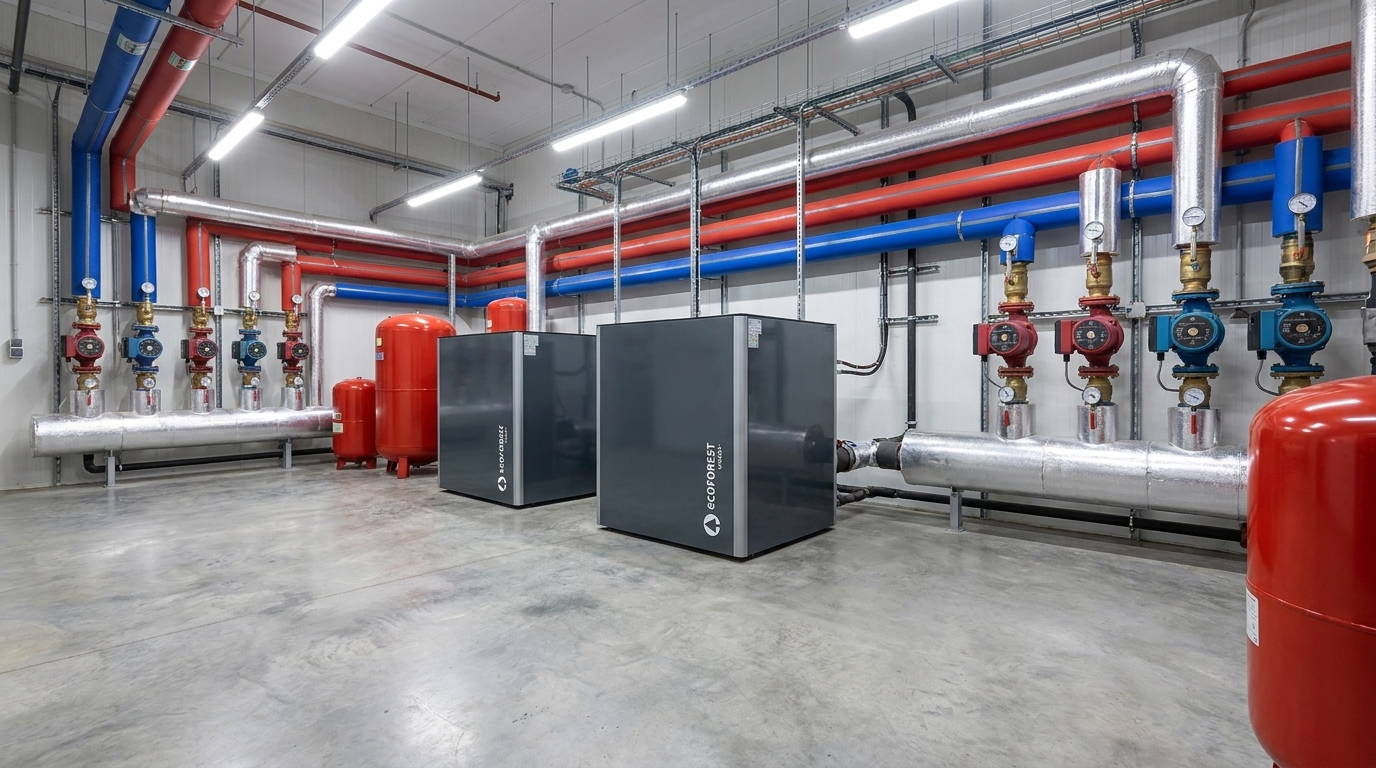
ecoGEO+ HP
Commercial-scale geothermal for building-wide domestic hot water and common area conditioning. A true gas boiler replacement that also handles cooling, keeping the ground loop in thermal balance year-round.
- 20 to 150 ton capacity range
- Full DHW production for the entire building, no gas connection needed
- Common areas: lobbies, gyms, coworking spaces, corridors
- Variable-speed compressor, continuous modulation
- 4-pipe hydronic output: simultaneous heating and cooling distribution
Why DHW-Only Geothermal Is a Loop Management Risk
Some developers have experimented with geothermal strictly for domestic hot water, leaving space conditioning on VRF or PTACs. The efficiency gains for DHW alone are real, but there is a loop management problem that often gets discovered too late: a DHW-only loop is always in extraction mode. You are taking heat from the ground every time a resident takes a shower or runs a dishwasher, and you are never injecting heat back in summer. Over time, the ground temperature around the bore field drops, efficiency falls, and in cold climates the loop can eventually approach temperatures that trigger freeze protection lockouts.
The Ecoforest approach solves this by designing the geothermal plant to handle both heating and cooling loads, so the loop stays in balance across seasons. A centralized plant that handles both DHW and common area cooling will inject heat back into the ground every summer, maintaining the thermal equilibrium that makes geothermal performance stable decade over decade.
Comparing the Options
| System | Efficiency vs VRF | Noise | DHW Included | No Outdoor Unit | Gas-Free |
|---|---|---|---|---|---|
| PTAC / Vertical Stack | Low | High | No | No | Often No |
| VRF + Gas Boiler | Baseline | Medium | Separate system | No (condensers) | No |
| Air-Source Heat Pump | Moderate | Medium | No | No | Yes |
| ecoGEO+ Compact (per unit) | +44% vs VRF | Silent | Yes | Yes | Yes |
| ecoGEO+ HP (centralized) | +44% vs VRF | Mech. room only | Full building | Yes | Yes |
The Financial Case for Multifamily Developers
The conversation about geothermal in multifamily has historically stalled on upfront cost. Bore field drilling adds to the construction budget in a way that window AC units and boilers simply do not. But that comparison is increasingly misleading for three reasons.
1. Energy Savings That Compound Over Time
A building running ecoGEO+ systems instead of VRF plus a gas boiler will save on the order of $400 per unit per year in energy costs based on current utility rates. For a 60-unit building, that is roughly $24,000 per year in operating cost reduction. Over a 20-year hold, the math is not close.
2. Federal Tax Incentives Under the IRA
The Inflation Reduction Act extended and expanded the Investment Tax Credit for geothermal systems. Commercial projects using geothermal heat pumps can qualify for a 30% ITC on qualifying system costs, with potential bonus credits for projects in energy communities or meeting domestic content requirements. For a significant geothermal installation, this credit can materially reduce the effective capital cost and shorten payback periods to under 8 years in many projects.
3. Market Positioning and NOI Premium
In Class A and luxury multifamily markets, the absence of window AC units and noisy PTACs is increasingly a selling point that justifies higher rents. Residents who understand what geothermal means for their utility bills will factor that into their willingness to pay. Buildings that can credibly claim all-electric, HVAC-integrated-into-walls, silent operation are differentiated in a way that improves both occupancy and Net Operating Income.
No Exterior Equipment
No rooftop condensers, no window units, no outdoor compressor noise. The facade stays clean and the street-level experience is unaffected.
All-Electric Ready
Geothermal eliminates the gas connection for space conditioning and domestic hot water, future-proofing the building against gas bans and carbon pricing.
Silent Operation
Variable-speed compressors that modulate continuously run far quieter than cycling on/off units. Residents notice the quiet, especially at night.
Stable Long-Term Costs
Geothermal loops have a 50-year design life. Equipment cycles are lower because the system never fights extreme outdoor temperatures.
Frequently Asked Questions
The right geothermal system for your multifamily building starts with the right design.
Our team provides free technical support for developers, MEP engineers, and architects: bore field sizing, hydronic schematics, load calculations, and system specification for multifamily projects across the U.S. and Canada.
Or subscribe for technical guides and case studies.
Keep reading