

Why Geothermal Costs More Upfront — And Why Luxury Homeowners Still Choose It
The honest, complete comparison: what geothermal actually costs, what it saves every month, how third-party ownership makes it possible with zero upfront investment, and the reasons the numbers alone do not explain.
Start With an Honest Comparison
The first number people hear about geothermal heat pump cost is always the installation figure. And yes, it is higher than a conventional HVAC system. But that comparison is almost never done fairly.
A large luxury home does not just need a gas furnace and an air conditioner. It needs space heating that serves radiant floors and fan coils across 8,000 to 12,000 square feet. It needs cooling. It needs domestic hot water for a household that uses a lot of it. And if there is an indoor pool or a spa, which most homes at this level have, that adds another system entirely. A conventional mechanical room for a home like this ends up with a boiler, a chiller or several air-source units, a water heater, and a pool heater. Four separate systems, four contractors, four maintenance contracts, and a mechanical room that fills up fast.
A geothermal system handles all of that from one compact installation. When you compare the complete picture, the upfront gap between geothermal and conventional is almost always smaller than people expect.
The Real Upfront Cost Comparison
The table below compares two complete mechanical systems for a large luxury home, 8,000 to 10,000 square feet with radiant floors, fan coils, domestic hot water, and an indoor pool. Both systems are fully specified; neither includes cost shortcuts.
| System Component | Conventional Installation | Geothermal (ecoGEO+) |
|---|---|---|
| Space heating | High-efficiency gas boiler + radiant manifolds: $18,000–$28,000 | ✓ Included in geothermal system |
| Space cooling | Chiller or multi-zone air-source system: $22,000–$38,000 | ✓ Included in geothermal system |
| Domestic hot water | High-capacity gas water heater: $3,500–$6,000 | ✓ Included in geothermal system |
| Indoor pool | Dedicated pool heat pump or boiler: $8,000–$15,000 | ✓ Included in geothermal system |
| Ground loop drilling | Not applicable | Vertical borehole field: $18,000–$35,000 |
| Heat pump units | Not applicable | ecoGEO+ cascade (2–4 units): $28,000–$55,000 |
| Total installed (before incentives) | $51,500–$87,000 | $46,000–$90,000 |
The ranges overlap. A complete geothermal installation for a large luxury home often lands in the same territory as the full set of conventional equipment it replaces. And that is before you factor in operating costs, which is where the real difference shows up year after year.
“Geothermal is not expensive. A gas boiler, a chiller, a water heater, and a pool heater bought separately are expensive. The comparison only makes sense when you put the full systems side by side.”
Third-Party Ownership: Zero Upfront, Savings From Month One
The federal residential geothermal tax credit (Section 25D) ended on December 31, 2025, so it no longer applies to systems purchased in 2026. State and utility programs still exist, but they vary widely by location. Third-party ownership (TPO) has become more relevant as a result: because a company owns the system instead of the homeowner, that owner may be able to use the federal commercial investment tax credit (Section 48), and that value can be reflected in the monthly rate. Terms differ by provider, so confirm eligibility with a tax advisor. In a TPO arrangement, a company finances and installs the geothermal system on your property and owns the equipment. You pay for the energy it produces, not for the hardware.
The logic is simple. Geothermal delivers heating, cooling, hot water, and pool conditioning at a small fraction of what conventional energy costs. The TPO company charges you a monthly rate that is set below your current energy bill. So from month one, you are spending less than before. The system does not require payback calculations because there is nothing to pay back. Your bills go down immediately.
“With third-party ownership, geothermal stops being a capital investment. It becomes a better energy contract. You pay less each month than you did before, and the company that owns the system carries all the performance risk.”
The Main TPO Models
Power Purchase Agreement (PPA)
The TPO company installs and owns the system at no cost to you. You pay per unit of thermal energy delivered — essentially per BTU/h consumed. The rate is set below your current energy cost from the start, creating immediate positive cash flow. The company handles all maintenance and guarantees system performance.
Geothermal Lease
Similar structure to a solar lease: a fixed monthly payment to the TPO company, regardless of energy produced. The payment is set below your current average energy cost, so the net effect is immediate savings. Maintenance and equipment replacement are the company’s responsibility throughout the lease term.
Energy Service Agreement (ESA)
The TPO company installs the system and is paid a percentage of the documented energy savings it generates. If the system saves you $12,000 per year, the company receives a share of that figure. You retain ownership of the savings above the agreed split. Performance risk sits almost entirely with the provider.
PACE Financing
Property Assessed Clean Energy financing eliminates the upfront cost by attaching the repayment to your property tax bill. The loan transfers automatically to the next buyer if the home is sold. Interest rates are typically low and terms run 10 to 25 years, making monthly payments manageable from day one.
How the Economics Work in Practice
A large luxury home spending $18,000 per year on gas heat, electric cooling, and hot water switches to geothermal under a PPA. The ecoGEO+ delivers the same services at a system operating cost of $4,500 per year in electricity. The TPO company charges $9,000 per year for the energy delivered. The homeowner’s net annual cost drops from $18,000 to $9,000 — a $9,000 saving in year one. The TPO company retains the margin between $9,000 and $4,500 to cover equipment cost, financing, and maintenance. Both sides benefit immediately.
Operating Costs: Where the Real Difference Shows Up
The upfront numbers matter, but they are not where the financial case for geothermal is strongest. That happens every month, on the energy bill.
The ecoGEO+ runs at COP 4.5 to 6.0 in standard heating and cooling mode. In practice, that means for every unit of electricity you put in, you get four to six units of thermal energy out. A high-efficiency gas furnace tops out at around 98% efficiency. It can never exceed 100% because it is burning fuel. Geothermal is moving heat, not creating it, which is why the math looks so different.
A large luxury home spending $14,000 a year on gas heat, electric cooling, and hot water can bring that down to roughly $4,000 to $5,500 with geothermal. The exact number depends on local utility rates and how much you use each function, but the direction never changes. Geothermal costs significantly less to run, every single year.
20-Year Cumulative Energy Cost Comparison
The chart below shows cumulative operating energy costs only — not installation — for a large luxury home over 20 years. Energy price inflation assumed at 3% annually.
ecoGEO+ geothermal (heating + cooling + DHW + pool)
Illustrative estimates. Conventional: $14,000/yr baseline rising 3% annually. ecoGEO+: $4,500/yr baseline at COP 5.0 average, rising 3% annually.
Over 20 years, cumulative energy savings versus a conventional system come to roughly $255,000, about $12,750 per year on average. The point where those savings cover any installation premium is typically somewhere between year 6 and year 8.
What Happens in Summer Changes the Math Entirely
The COP numbers above are averages. In summer, with the HTR function active, the real efficiency is significantly higher.
When the system is cooling the house, it extracts heat from the interior and needs to send it somewhere. With the HTR function, that same heat gets redirected to your domestic hot water tank and pool instead. You are already removing it from the house, so producing hot water costs you essentially nothing extra.
The combined efficiency during this simultaneous operation can reach COP 7 or even COP 8. You are running the air conditioning and getting all your hot water and pool heating at the same time, from the same refrigeration cycle. No conventional setup can do this.
What That Looks Like on a July Bill
A typical large luxury home in summer spends around $400 on air conditioning and $180 on hot water, roughly $580 per month. With the ecoGEO+ running simultaneous cooling and DHW via HTR, that same output costs about $70 in electricity. The heat coming out of your living spaces is doing two jobs: cooling the rooms and filling the hot water tank, from the same refrigeration cycle.
What the Numbers Do Not Capture
The financial case for geothermal in a luxury home is solid enough to stand on its own. But most people who choose it at this level are not running payback calculations. They are choosing it because of what it actually feels like to live in the home.

No outdoor equipment
Every conventional system needs condenser units somewhere around the building. On a home where the terrace, pool deck, and landscaping represent serious design investment, those units are a real compromise. They occupy space, need clearance zones, and their presence shapes what the outdoor environment can be. With geothermal there is nothing outside. The only thing visible at grade is a small access cover over the ground loop connections.
Silence on the property
Condenser fans cycle on and off all day and all night. After a while that cycling becomes a background texture the home always has. You notice it most on a quiet morning by the pool, or in a bedroom near the mechanical yard. Geothermal removes it completely. The heat pump is inside the mechanical room and its operating noise never reaches occupied spaces or the garden.
Comfort that forced air simply cannot match
Radiant floor heating keeps room temperature within less than one degree of setpoint continuously, with no air movement and no temperature swings. In a cold climate, the difference over a full winter is something guests notice without being able to name exactly what it is. The home just feels comfortable in a way that other homes do not.
No combustion anywhere on the property
A gas boiler burns fuel. That brings gas lines, combustion air requirements, flue venting, and carbon monoxide risk. Geothermal is entirely electric. There is no combustion anywhere in the system. For owners building to net-zero standards, or in areas moving away from natural gas connections, this is not a preference. It is the only path that works.
A System Built to Last as Long as the Home
The ground loop buried under the property has a design life of 50 years or more. The heat pump itself runs 20 to 25 years with normal maintenance, compared to 15 to 18 years for a conventional boiler or chiller. Over the full ownership period of a large luxury home, there is a good chance the geothermal system never needs replacing at all, while a conventional setup will require at least one full capital reinvestment.
Maintenance is also much simpler. No combustion system to service, no flue to inspect, no gas pressure to check. Annual visits cover refrigerant pressure, electrical connections, and hydronic flow. The ground loop needs essentially nothing once it is in the ground.
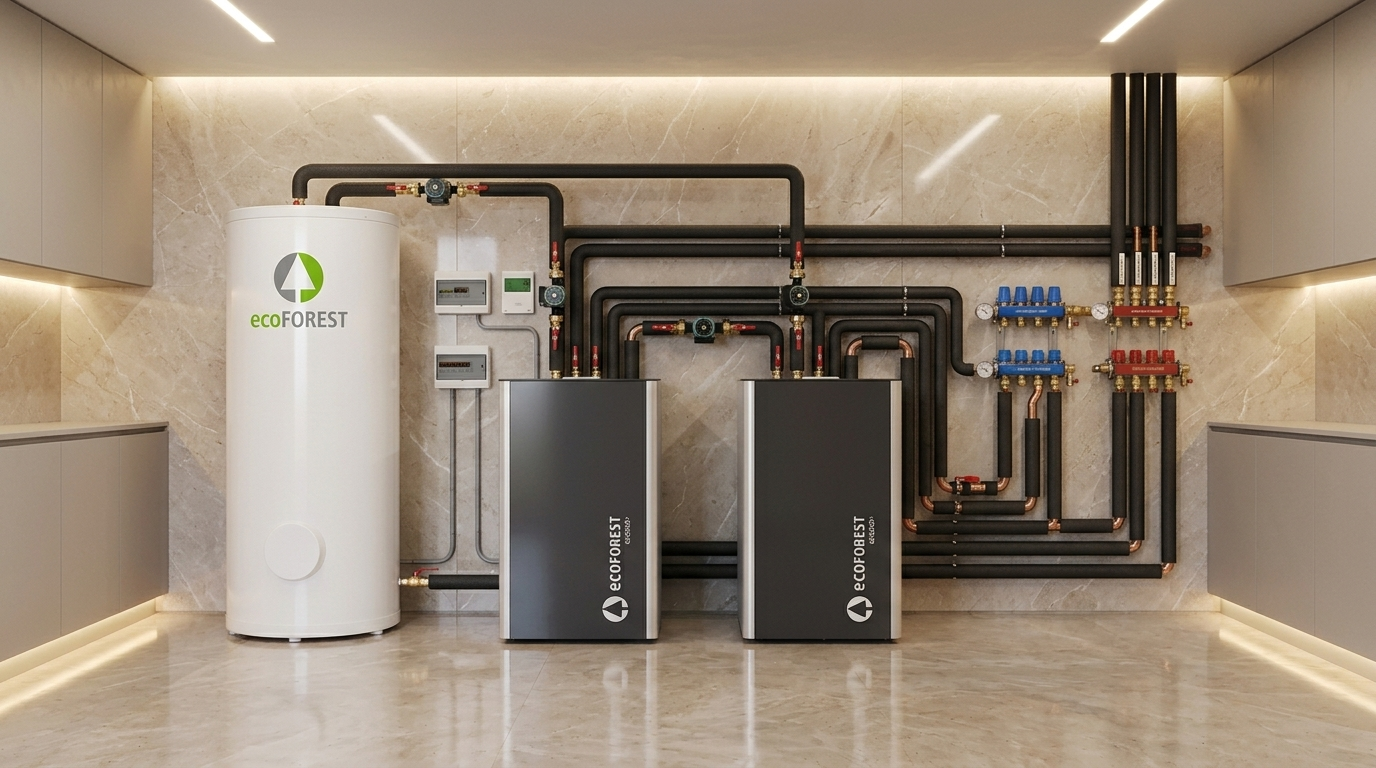
ecoGEO+ for Luxury Homes
Full-inverter water-to-water geothermal designed for large residential installations. Handles heating, cooling, domestic hot water, and pool from a single system with no outdoor equipment and no combustion.
- COP 4.5 to 8.0 depending on operating conditions and whether the HTR function is active
- Full inverter compressor with quiet continuous modulation from 20% to 100%
- R454B refrigerant with low global warming potential
- Handles radiant floor, fan coil, DHW, and pool from a single system
- Cascade up to 6 units on a shared hydronic loop
- No outdoor condenser unit and nothing visible on the terrace or garden
- Built-in electric backup so the home is never left without heat
- 204 to 240V / 60Hz for North American electrical installations
- 50+ year ground loop life, outlasting the equipment above it
When to Make the Decision
Geothermal is most cost-effective when it goes into the design from the start. The ground loop needs to be sized and drilled before the landscaping is done. The hydronic distribution needs to be in the structural and mechanical drawings before walls close. Retrofitting geothermal into a finished site is possible but adds cost and sometimes involves compromises that a new build avoids completely.
For architects and builders, the conversation about geothermal belongs in schematic design, not at construction documents. The system needs to be on the mechanical drawings before the site plan is locked, so the ground loop location, the mechanical room footprint, and the hydronic pathways are all coordinated from day one.
If you are renovating and the existing mechanical system is near end of life, replacing it with geothermal makes strong financial sense. You avoid the cost of a conventional replacement and start capturing energy savings immediately. Our team can help you work through the timing for your specific project.
Planning a new build or renovation?
Our team provides a free project analysis: system sizing, ground loop design, 20-year cost model with your local energy rates, and current incentive eligibility. No sales pitch, just the numbers.
Frequently Asked Questions
For a large luxury home (6,000 to 12,000 sq ft), a complete geothermal system including heat pump units, ground loop drilling, and hydronic distribution typically ranges from $60,000 to $120,000 installed. However, with third-party ownership models such as a PPA or geothermal lease, the upfront cost is zero. The monthly payment is structured below your current energy costs, so the net effect is positive cash flow from the first month.
Third-party ownership (TPO) means a company finances, installs, and owns the geothermal system on your property. You pay for the energy it delivers rather than buying the equipment. The main models are Power Purchase Agreements (pay per BTU/h produced), geothermal leases (fixed monthly payment below your current bill), Energy Service Agreements (pay a share of documented savings), and PACE financing (repaid through property taxes, transfers with the home).
With a direct purchase, most large residential geothermal installations achieve full payback within 6 to 9 years through energy savings alone. The ecoGEO+ operates at COP 4.5 to 6.0 in heating and cooling mode, and above COP 7 to 8 in summer when simultaneous cooling and domestic hot water production share the same refrigeration cycle. Annual operating savings in a large luxury home typically range from $8,000 to $14,000 compared to a conventional gas and electric system. With a TPO model, payback is immediate — you spend less from month one.
For most owners of large luxury homes, the question is less about payback period and more about what the system delivers. Geothermal eliminates outdoor condenser units, removes all mechanical noise from the property, enables silent radiant floor heating and hidden fan coil cooling, and reduces the mechanical room to a single compact system. These outcomes cannot be replicated by any conventional system at any price.
Yes. Ground-source geothermal draws heat from a stable underground temperature of 45 to 55°F regardless of outdoor air temperature. Unlike air-source heat pumps, which lose efficiency as outdoor temperatures drop, a geothermal system maintains consistent COP throughout winter. In the coldest climates in North America, the ecoGEO+ delivers full rated heating capacity with no efficiency penalty.
A water-to-water geothermal system like the ecoGEO+ replaces a gas or oil boiler, a cooling chiller or air-source system, a domestic water heater, and a pool heater. In a cascade installation, all these functions are handled from one compact technical room with one control interface and one maintenance relationship, while producing zero combustion emissions on-site.

Get a free project cost analysis for your home.
System sizing, ground loop design, 20-year cost model, and current incentive calculation — tailored to your location, home size, and project timeline. No obligation.
Or subscribe for technical guides and case studies.

One Response