
Geothermal vs. Air-Source Heat Pump: Which Is Right for Your Home in 2026?
Side-by-side comparison of geothermal vs. air-source heat pumps for U.S. homes. Costs, efficiency, climate performance, lifespan, ROI—everything you need to decide.
- Air-source heat pumps cost $9,000–$20,000 installed and deliver 300–350% efficiency (COP 3.0–3.5). Best for retrofit, mild climates, and homeowners with limited upfront budget.
- Geothermal heat pumps cost $18,000–$45,000 installed and deliver 400–520% efficiency (COP 4.0–5.2). Best for new construction, cold climates, large homes, and 20+ year ownership horizons.
- Geothermal wins on: efficiency, lifespan (20–25 years vs 15), cold-weather performance, noise, and home resale value. Air-source wins on: upfront cost, installation simplicity, and faster deployment.
- After the Section 25D residential tax credit expired (Dec 31, 2025), the financial gap narrowed. State rebates, utility programs, and the commercial Section 48 ITC (30%) can still tip the math toward geothermal.
- A hybrid approach (geothermal for primary heating + an air-source unit for shoulder seasons or ductless zoning) is increasingly common in custom homes.
Geothermal vs. Air-Source: Quick Comparison Table
| Factor | Geothermal (GSHP) | Air-Source (ASHP) |
|---|---|---|
| Typical installed cost | $18,000–$45,000 | $9,000–$20,000 |
| Efficiency (COP) | 4.0–5.2 | 3.0–3.5 (modern cold-climate) |
| Cooling efficiency (EER/SEER2) | EER 30+ | SEER2 16–22 |
| Cold-climate performance | Unchanged (loop is stable) | Drops below 5 °F outdoor |
| Lifespan (heat pump unit) | 20–25 years | 12–15 years |
| Lifespan (loop) | 50+ years | N/A |
| Outdoor footprint | None (loop is buried) | Outdoor condenser unit |
| Noise | Very low (no outdoor unit) | Moderate (outdoor fan) |
| Installation time | 2–5 days (loop drilling) | 1–2 days |
| Yard impact | Significant during install | Minimal |
| Federal tax credit (2026) | 25D expired; Section 48 available for commercial | 25C expired |
| Best for | New construction, cold climates, long ownership | Retrofit, mild climates, budget-conscious |
How Each Type Works
How Air-Source Heat Pumps Work
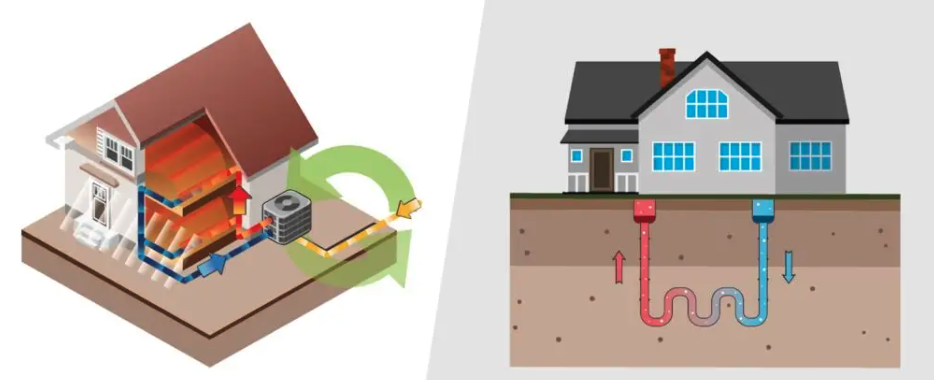
An air-source heat pump (ASHP) transfers heat between the air inside your home and the outdoor air. It looks similar to a standard central air conditioner, with an outdoor condenser unit and an indoor air handler (or, in ductless systems, multiple indoor heads).
In summer, it pulls heat out of indoor air and dumps it outside—just like an AC. In winter, it reverses the cycle, extracting heat from outdoor air (even cold air contains heat energy) and bringing it inside.
Modern cold-climate ASHPs with variable-speed inverter compressors can operate efficiently down to -15 °F or lower. But efficiency drops as outdoor temperature falls. At 47 °F, a high-end ASHP might deliver COP 3.5. At -5 °F, the same unit might deliver COP 2.0—still better than electric resistance, but a significant degradation.
How Geothermal Heat Pumps Work
A geothermal heat pump (GSHP) transfers heat between your home and an underground ground loop filled with water/antifreeze. The ground stays a constant 45–60 °F year-round, so the heat pump never faces the temperature extremes that punish air-source efficiency.
In heating mode, the loop fluid absorbs heat from the warm earth and delivers it to the heat pump unit, which concentrates it and distributes it through the home. In cooling, the cycle reverses—heat is extracted from your home and dumped into the cool ground.
Because the loop temperature is stable, a geothermal system delivers the same COP at 0 °F outdoor air as it does at 50 °F. There is no cold-climate performance penalty. For a deeper technical breakdown, see The Complete Guide to Geothermal Heat Pumps.
Installation Costs Compared
Air-Source Heat Pump Costs
A complete air-source installation in the U.S. typically costs:
- Ducted central ASHP: $9,000–$18,000
- Ductless mini-split (single zone): $4,500–$7,500
- Ductless multi-zone (3–5 heads): $12,000–$22,000
- Cold-climate variable-speed ASHP: $14,000–$22,000 (premium tier)
Geothermal Heat Pump Costs
- Horizontal loop, average home: $20,000–$32,000
- Vertical loop, average home: $26,000–$45,000
- Premium 6-in-1 system with hydronic + DHW + pool: $35,000–$60,000+
The loop installation accounts for 40–60% of the geothermal total. This is the cost driver that makes geothermal expensive—but also why the system lasts 50+ years.
Operating Costs and Energy Efficiency
This is where geothermal pulls ahead decisively.
For a 2,500 sq ft home in the Northeast with $0.22/kWh electricity:
| System | Annual Heating/Cooling Cost | Lifetime Cost (20 yr) |
|---|---|---|
| Gas furnace + AC | ~$2,800 | $56,000 |
| Air-source heat pump (modern) | ~$1,600 | $32,000 |
| Geothermal heat pump (variable-speed) | ~$900 | $18,000 |
Across 20 years, geothermal saves $38,000 vs gas and $14,000 vs air-source. That delta typically exceeds the upfront cost premium, even without tax credits.
In milder climates or lower energy-cost regions, the savings narrow but remain real.
Climate Performance Compared
Cold Climate Performance
This is the single biggest functional difference between the two technologies.
- Air-source: efficiency drops as outdoor temperature falls. Even premium cold-climate ASHPs see their COP drop from 3.5 (at 47 °F) to 1.8–2.2 (at -5 °F). Below about -15 °F, most systems either shut down or switch to electric resistance backup—which is expensive.
- Geothermal: efficiency is unchanged. Loop temperature stays at 45–55 °F regardless of outdoor weather. A geothermal system delivers full rated capacity at -30 °F just as it does at 50 °F.
If you live anywhere in the U.S. that regularly sees temperatures below 0 °F (Minnesota, North Dakota, upstate New York, northern New England, Wisconsin, Michigan, Wyoming, Montana, Maine, parts of Colorado), geothermal is the technically superior choice.
Hot Climate Performance
In hot climates, the gap narrows but geothermal still wins on cooling efficiency. The ground stays cooler than ambient air in summer, giving geothermal units an EER 30+ vs SEER2 16–22 for air-source. In hot-humid climates (Florida, Texas, Gulf Coast), geothermal also dehumidifies more aggressively.
Lifespan and Maintenance
- Air-source: heat pump unit 12–15 years. Outdoor condenser exposed to weather, UV, debris. Compressor wear from frequent on/off cycling (single/two-stage units).
- Geothermal: heat pump unit 20–25 years. No outdoor exposure. Compressor runs at modulated speeds with less mechanical stress. Ground loop 50+ years.
Maintenance is similar in cost—a couple hundred dollars per year for filter changes, refrigerant checks, and occasional fluid top-offs. Both should be serviced annually.
Which Is Better for…
New Construction
Geothermal wins. Loop installation is cheapest before landscaping and hardscape exist. Hydronic distribution can be integrated into the foundation (radiant floor). Long ownership horizon by definition. Builders working on Section 48 ITC-eligible developments should default to geothermal.
Existing Homes with Ductwork
Both are viable. If yard access permits, geothermal delivers 20+ years of premium performance. If budget is tight or yard access is poor, modern variable-speed cold-climate ASHPs are a strong choice.
Cold Climate Homes
Geothermal wins decisively. No cold-weather performance penalty. No backup heat needed. No outdoor unit to ice over.
Homes with a Pool, Hot Tub, or Driveway Snow Melt
Geothermal wins—if you choose a 6-in-1 unit. Standard ASHPs cannot heat pools or melt ice. A geothermal system like the Ecoforest ecoGEO+ WWA integrates heating, cooling, domestic hot water, pool heating, and ice melting into a single chassis—eliminating multiple separate appliances and reducing total system cost. Learn more about 6-in-1 heat pumps.
Net-Zero Homes with Solar PV
Geothermal is the clear default. The lower kWh consumption means smaller PV array, smaller batteries, and easier net-zero math. Premium systems with solar PV hybridization (like Ecoforest’s ecoSMART easynet) automatically prioritize solar surplus.
Tight Budget, Short Ownership
Air-source wins. Lower upfront cost, faster install, payback works on a 7–10 year horizon. If you may move in under 10 years, an ASHP is the safer bet.
The Hybrid Approach: Best of Both Worlds
Some sophisticated installations combine the two:
- Geothermal for primary heating and cooling (handles 80–90% of load)
- Ductless air-source mini-splits for zoning (specific rooms, additions, in-law suites, garages)
- Air-to-water heat pump for radiant floor + pool, paired with geothermal for forced air
This approach is increasingly common in custom homes, high-end multifamily, and luxury renovations where comfort, efficiency, and zoning flexibility all matter.
Geothermal vs. Air-Source FAQs
Is geothermal more efficient than air-source?
Yes. Geothermal delivers COP 4.0–5.2 vs 3.0–3.5 for modern air-source. The efficiency gap widens further in cold weather, when air-source COP drops significantly while geothermal remains stable.
Is geothermal worth the extra cost over air-source?
In cold climates, new construction, and 20+ year ownership horizons—yes. In mild climates with short ownership or tight budgets, air-source often wins financially.
Can I replace my furnace with a heat pump?
Yes, with either technology. Air-source is the more common retrofit because installation is simpler. Geothermal retrofits are possible but require yard access for the loop.
Does a geothermal heat pump work in extreme cold?
Yes—better than air-source. The ground loop temperature is stable at 45–55 °F regardless of outdoor weather, so a geothermal unit delivers full performance at -30 °F just as it does at 50 °F.
How long does an air-source heat pump last vs. geothermal?
Air-source: 12–15 years. Geothermal: 20–25 years for the unit, 50+ years for the ground loop.
Can one heat pump heat my home and my pool?
A standard air-source unit cannot heat pools. A 6-in-1 geothermal system like the Ecoforest ecoGEO+ WWA can heat your home, cool your home, generate domestic hot water, heat your pool, and even melt snow on your driveway—all from a single unit.
Which is quieter, geothermal or air-source?
Geothermal is significantly quieter. There is no outdoor condenser, and the indoor unit’s variable-speed compressor runs at lower RPM most of the time.
Did the federal tax credit expire for both?
The Section 25C credit for air-source heat pumps and the Section 25D credit for geothermal both expired for systems placed in service after December 31, 2025, under the One Big Beautiful Bill Act. However, state, utility, and commercial Section 48 incentives remain. See our 2026 Heat Pump Rebates Guide.
Can I qualify for the commercial 30% ITC on a residential rental?
Yes—Section 48 applies to leased residential, multifamily, and commercial installations. This is a major opportunity for landlords, developers, and rental property owners.